[2] Why I Began Thinking This Way
The questions kept multiplying. If I don't know who I am, how can I live as myself? If I can't live in a way that is truly mine, does my life have any meaning? Then what does it mean to be "myself"? What does it mean to live? And what does it mean to live meaningfully?

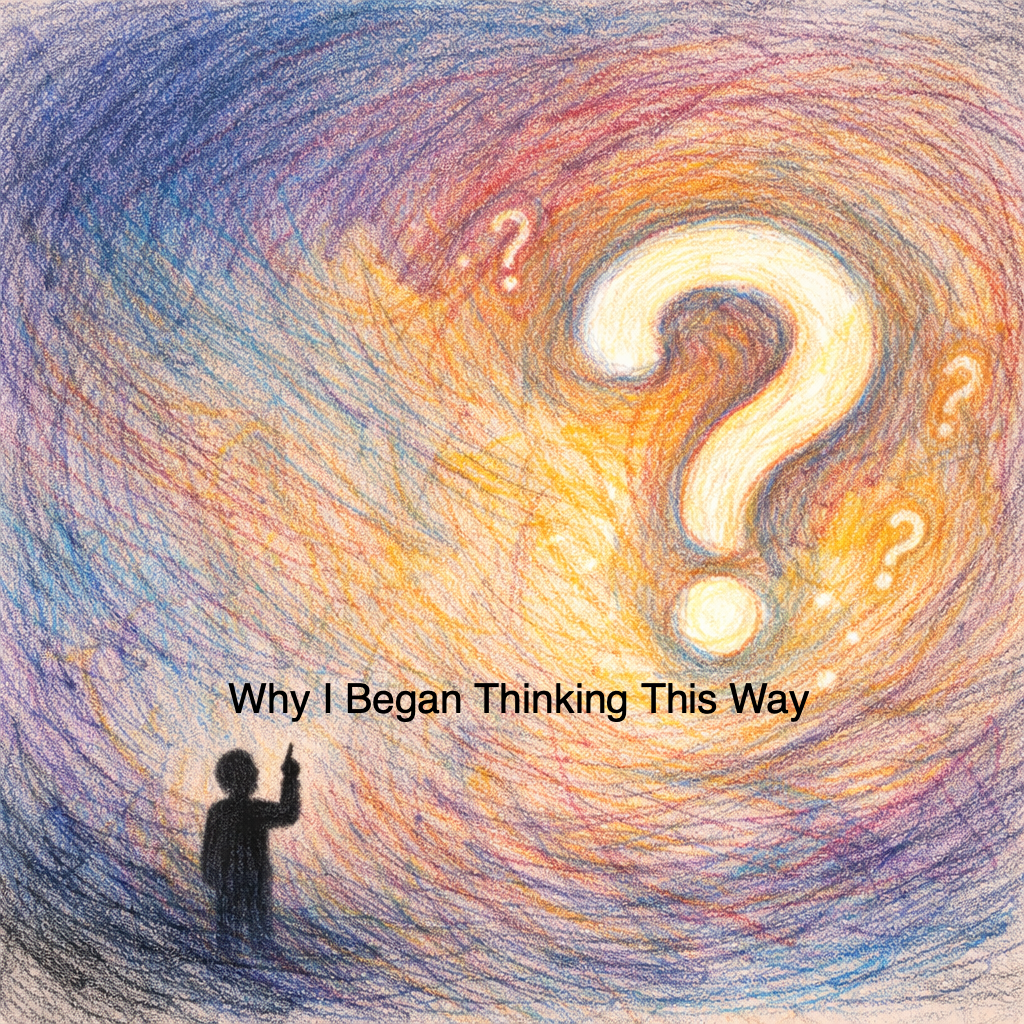
1. The Question That Changed Everything
I was in my second year of middle school, around fifteen years old. At the beginning of the semester, while flipping through a moral education textbook, I came across a sentence. It said that when people reach adolescence, many begin to ask themselves, "Who am I?"
It was probably a line most students skimmed over without a second thought. But for me, that single sentence quietly redirected the course of my life. The moment I seriously asked myself, "Who am I?", everything that had once seemed important suddenly lost all its force.
From that day on, I spent nearly the entire day absorbed in that question. This is no exaggeration—it really was like that. While eating, while walking down the street, my mind was filled with nothing else. At one point, exhausted from thinking too much, I even resolved to try not thinking at all for a month. But when that month passed, I reached another conclusion: thinking was better after all—a thought in itself.
The questions kept multiplying. If I don't know who I am, how can I live as myself? If I can't live in a way that is truly mine, does my life have any meaning? Then what does it mean to be "myself"? What does it mean to live? And what does it mean to live meaningfully?
My teenage years flowed by quite earnestly alongside these questions.
2. Why I Chose Philosophy
That was why I chose philosophy. To be honest, at the time I didn't really know what studying philosophy actually involved. I only sensed that it was a place where questions like these were taken seriously. Despite considerable opposition from my parents and people around me, I stubbornly applied to the philosophy department.
Some joked that I could make good money opening a fortune-telling shop—in Korea, these are amusingly called "philosophy parlors" (철학관, chörhakkwan)—though the distance between reading fortunes and reading Plato hardly needs explanation.
To put it simply, I did not find an 'answer' to this question in the philosophy department. Because philosophy is not a discipline that provides answers to "Who am I?" One might think of Socrates or Plato and find this puzzling. But Socrates' famous phrase, "Know yourself," was less about defining one's identity and more a call to examine one's life. When you open the books philosophers left behind, you mostly find discussions of being, truth, good and evil, justice, and beauty.
3. What Philosophy Left Me With
That doesn't mean studying philosophy was in vain. My thinking gained depth, my perspective on the world broadened, and above all, I learned 'how to ask questions.'
I also came to understand that what truly matters is not the answer but the question. A problem does not end with an answer—it becomes something new only when it leads to a better question. When the question changes, the world begins to look different.
Consider this difference, for example. "Who am I?" and "What kind of person am I?" are entirely different questions. Likewise, "How should I live?" and "What job should I have?" are not the same at all. When the question changes, the path changes with it. That is why a question serves as a guide while also being, in itself, an answer.
4. To live as myself
As life goes on, you sometimes find yourself on a road from which you cannot easily turn back. There are times when you feel you've come too far already, and times when you've spent too long living behind a mask. The more this happens, the more people stop asking questions. Because facing oneself as one truly is can be overwhelming.
Still, we must not completely forget how to ask. Because one day, those questions may return and give us the strength to live in our own way again.
Asking who I am and how I should live ultimately begins with a single wish: to live as myself. I chose a philosophy department that teaches no direct survival skills for making a living, simply because I wanted to live my life and leave this world in my own way.
Not like you. Not in your way. But only in mine—in my own way.
That is perhaps the most important meaning a life can have.
I hope you’ll find a moment to meet it.
 김대근 DAEGEUN KIM
 김대근 DAEGEUN KIM
 김대근 DAEGEUN KIM