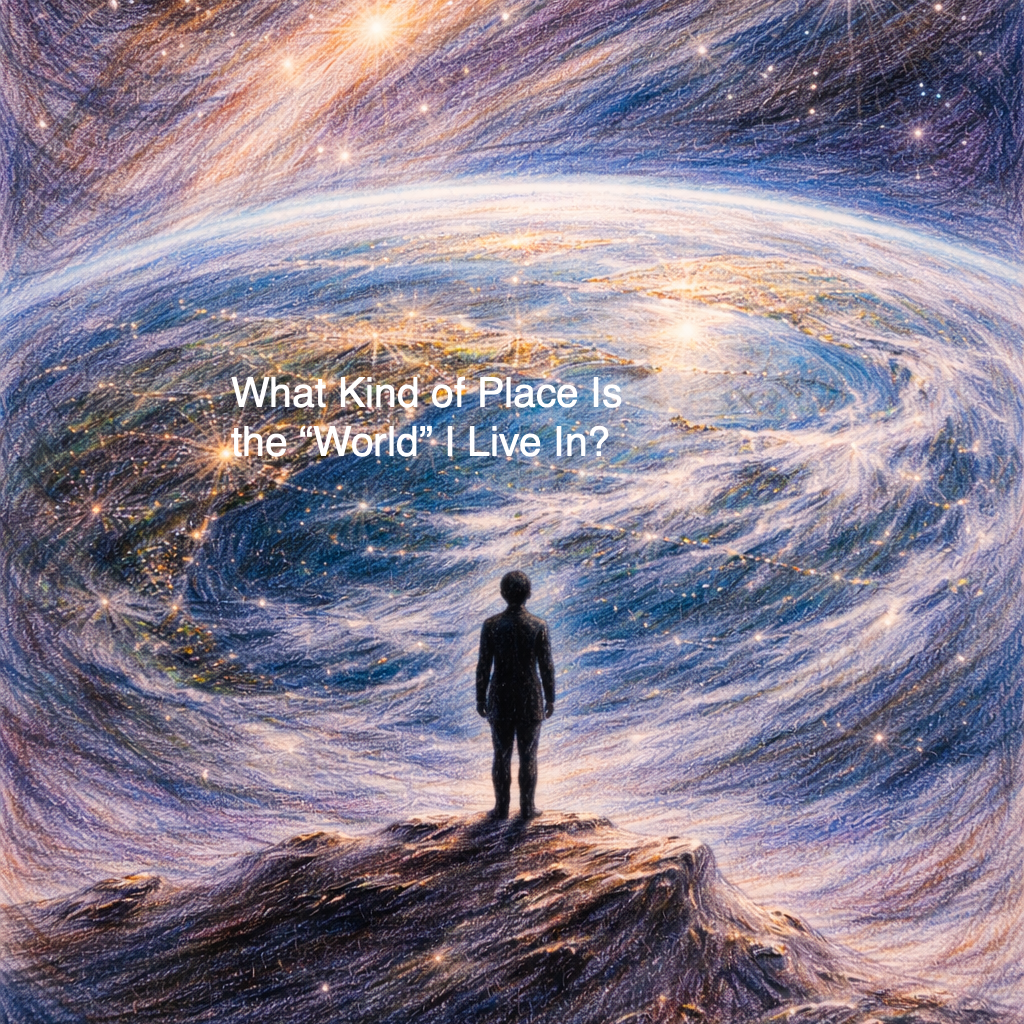
[6] What Kind of Place Is the “World” I Live In?
That is why the question, “What is the world?” ultimately becomes another: “What does this world mean to me?” It is a process of searching for meaning while drawing my own map of the place I call home.

1 The View That Sets My Direction
Everyone is curious about the world they live in—and we learn about it, little by little. But in a philosophical sense, the “world” doesn’t simply mean a geographic place from a textbook. It includes both the physical space I breathe in and move through, and the meaningful space where my mind settles and interprets life.
That is why the question, “What is the world?” ultimately becomes another: “What does this world mean to me?” It is a process of searching for meaning while drawing my own map of the place I call home.
How you look at the world can completely change the direction of your life. Of course, the everyday places we move through—home, school, work—matter. But it is equally important to understand the invisible spaces that shape our lives: history, culture, science, and art. Even when we can’t point to them on a map, they quietly determine how we see, judge, and choose.
In the past, philosophy took on the massive job of explaining this vast “world.” Today, many academic fields share that role—physics, sociology, medicine, and more. Philosophy, instead, returns to its original task: asking the fundamental question on top of what those fields have built: “So, what meaning does this knowledge give to our lives?”
2 From “What Is It?” to “What Will I Make?”
More than physical location, what shapes us deeply is the space of perception—how we feel and interpret the spaces we inhabit. The same house can be the warmest shelter in the world for one person, yet a cold, suffocating prison for another. The same goes for school, work, and even the nation. Depending on its structure, its people, and the way I interpret it, the “world” I experience can look completely different.
Inside this space of perception, we search for meaning. We examine our limits and test the possibilities available within them. The more clearly we understand the conditions around us, the more likely we are to make wiser choices.
In the end, the world is both an object of objective knowledge and a space of meaning—rebuilt through a person’s interpretation and struggle. Contemplating how we want to live, finding hope that helps both ourselves and others, and shaping this place into somewhere better—this is the real work the question “What is the world?” invites us to do.
The world is also a space of possibility—a realm that can become more than whatever we imagine. But possibility doesn’t turn into reality on its own. The door opens only when our will and effort are added to it.
So the question “What is the world?” eventually comes to rest in a different form: “What kind of world will I build from here?”
I hope you’ll find a moment to meet it.
 김대근 DAEGEUN KIM
 김대근 DAEGEUN KIM
 김대근 DAEGEUN KIM