[7] How Should I Live—and What Should I Do?
“How should I live?” Once you grow up and find yourself thrown into the world, this question arrives like fate. And once you start worrying about how to live, you naturally end up asking who you are.

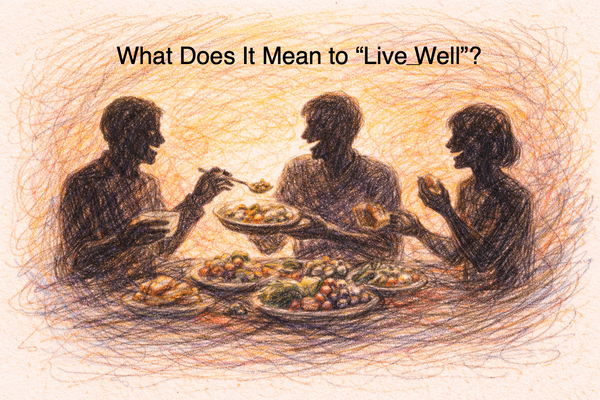
![[7] How Should I Live—and What Should I Do?](/content/images/size/w1200/2026/02/ChatGPT-Image-2026----2----19-----------05_49_20-1.png)
1 An Obvious Question You Can’t Avoid
“How should I live?” Once you grow up and find yourself thrown into the world, this question arrives like fate. And once you start worrying about how to live, you naturally end up asking who you are. Along the way, everything gets tangled together—your goals, your desires, moral values, material comfort, and even your relationships.
It’s complicated. But if you want to live as the owner of your own life, this is a question you eventually have to pass through.
This question is firmly rooted in reality. It asks what kind of work you’ll do to live out what you value, what kind of job you’ll choose, and what kind of attitude you’ll practice day by day. When you try to translate your values into real life, you will hit walls. But it’s often in front of those walls that you begin to grapple with something more serious: your real life.
In a way, this question is also a form of self-encouragement. Many people live the way they’ve always lived, doing what they’ve always done. Sometimes a massive barrier stands in front of you—something that feels impossible to change no matter how hard you try.
But if you don’t even attempt to push through, you may end up circling the track someone else drew for you for the rest of your life.
2 Beyond “How”—to “What”
That’s why “How should I live?” becomes a painful kind of reflection: What kind of mind am I living with right now? And at the same time, it can be a short shout that wakes you up.
If “How should I live?” is about setting the direction of your life, then “What should I do?” is the method that actually moves your body toward that direction. It’s like saying, “I want to live like this,” and hearing the next question immediately follow:
“Okay—so what are you going to do, starting now?”
It’s the question that pulls you out of a room where you only think and never act. It’s a decision to get up, to do something, to make something happen—like the brief moment when Hamlet’s anguish finally crosses the line into action.
3 The Moment You Meet a Stranger Called “Me”
Sometimes, out of nowhere, you run into a question like this:
“Who have I been living for—and for what?”
When you stand in front of that question, even the self you thought you knew can suddenly feel unfamiliar. And strangely, that moment—when you feel like a stranger to yourself—can become the chance to recognize yourself anew.
If you simply go with the flow, it’s easy to miss the “moment of decision,” the moment when you choose with your own will. But if you stop and ask, at the very least, you can take the steering wheel back into your hands.
A decision means choosing without endless hesitation in front of something that matters. Not just problems of survival, or pain that demands immediate attention, but a vow from the soul: “This is one thing I will do, no matter what.”
If you’ve never met such a moment, maybe now is the time to drop an anchor for your thoughts.
4 Existence: Choosing—and Owning the Result
What does it mean to exist?
It’s not a life that only moves when something is handed to you. It’s closer to a kind of wild life-force: even if you go hungry for a while, you still go out and search for your own food. It means you’re not simply placed in the world like an object—you function as a living being, dynamically, from the inside out.
Even when the world doesn’t go your way: thinking for yourself, acting for yourself, trying, accepting, and choosing again. And then, willingly taking responsibility for what follows.
That is what an existing person looks like. And the moment you make a promise to yourself—“I will live like that, too”—something like a real life begins.
I hope you’ll find a moment to meet it.
 김대근 DAEGEUN KIM
 김대근 DAEGEUN KIM
 김대근 DAEGEUN KIM