[10] Talk About Philosophy in an Age Without Conversation?
Philosophy cannot solve every problem in life. But it offers us something vital: reflection and doubt. To admit our own incompleteness and to rigorously examine our own beliefs—this is the true usefulness of philosophy.

1. A Society That’s Turned Into a War to Win
When I look at our society these days, I often find myself deeply worried. People seem to split into extremes, treating the other side as nothing more than an enemy to be defeated. This isn’t a sports game where winning and losing is the whole point; it is far harsher. One group mocks and tramples another, pushing them out until they have nowhere left to stand.
Instead of listening, people gather only with those who think like them, wielding their own version of “justice” like a weapon. Common sense feels like a distant memory, and true conversation has been missing for a long time. In this void, sharp words easily turn into violence.
Of course, human beings are creatures of desire and emotion. Even with reason, we cannot be rational all the time. Everyone makes mistakes, and sometimes, people do harm. Changing a belief once it has hardened is one of the hardest things in the world. Being honest, opening up, and talking without armor—none of this is easy.
And yet, we must push through this difficulty. Only beyond it can we find new possibilities. The real purpose of a struggle or a debate is not to force surrender—it is to understand. Even when we stay on opposite sides, we can choose an attitude that tries to analyze the problem and look for a way forward together. The goal is not to embarrass the other, but to find a way for all of us to live. That is the essence of conversation we must recover.
(Listen to this soundtrack while you read to immerse yourself deeper into the reflection.)
2. Sharing Better Thoughts in the “Square”
Humanity has always moved forward by sharing better thoughts with more people. Someone might ask: in a world where we’re so busy just surviving, what good is all this? But it is precisely because people endured this difficult process that we have made it this far.
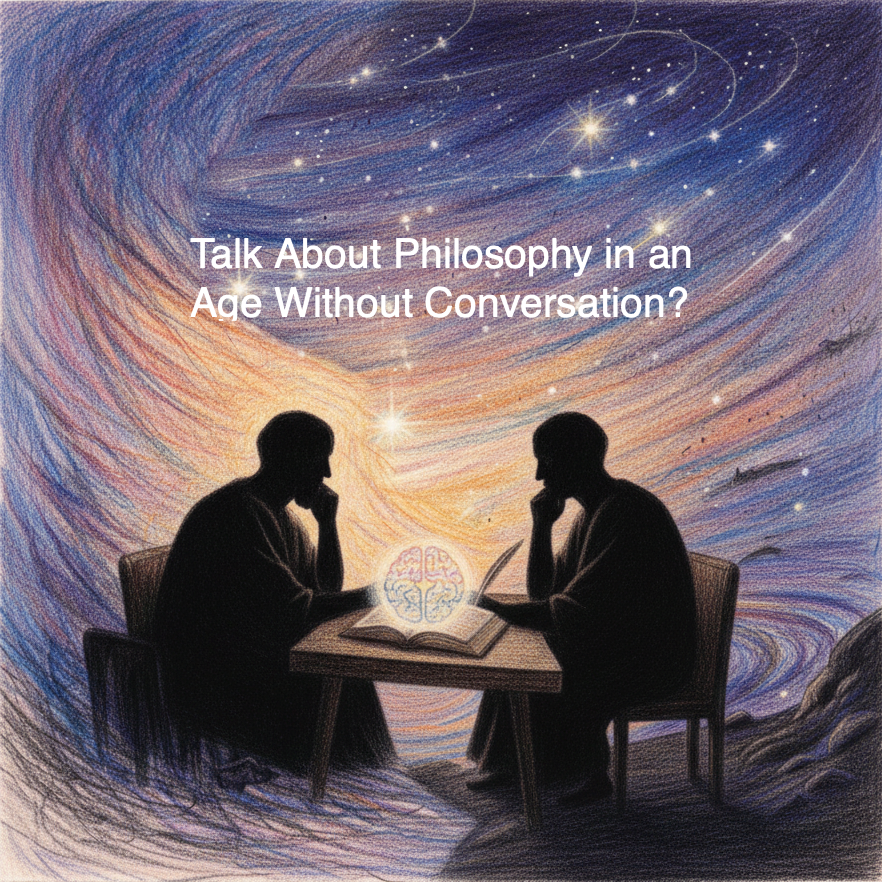
The moment we stop thinking in our own corners, change stops. If we refuse to learn from others, our lives remain stagnant. That is why we must step into the “square”—the place where people gather. When we discuss and share there, thought finally becomes a force that can move the world.
“I am willing to share my thoughts with you. I am open to a conversation.” If this simple belief could become our foundation, then even if our problems aren't solved overnight, we can still live with hope. Knowing that you can talk with someone you share this life with provides a sense of emotional stability.
I know how idealistic this sounds, and how it might feel like empty talk to some. I struggle with it too. There are times when I find it impossible to understand the person standing right beside me. And yet, I can't bring myself to give up.
Philosophy cannot solve every problem in life. But it offers us something vital: reflection and doubt. To admit our own incompleteness and to rigorously examine our own beliefs—this is the true usefulness of philosophy.
Trying to see differently and more deeply is what it truly means to “think.” Through doubt, critique, reflection, and imagination, we gain new ways of understanding ourselves and the world. I believe these perspectives can lead to changes that create a better life. If not there, then where else can we find hope?
 김대근 DAEGEUN KIM
I hope you’ll find a moment to meet it.
 김대근 DAEGEUN KIM
![[AI 영화] 인간의 궤도 The Human Orbit](https://storage.ghost.io/c/8c/73/8c730e7f-ab2f-44fd-8eb0-508372248311/content/images/size/w600/2026/09/6138748657294053777.jpg)
![호메로스의 서사시에 얽힌 그리스의 역사 [나른하니즘: 역사 #01]](https://storage.ghost.io/c/8c/73/8c730e7f-ab2f-44fd-8eb0-508372248311/content/images/size/w600/2026/09/-------1.png)
![13화 소크라테스의 위대함에 대하여 ② [나른하니즘: 철학]](https://storage.ghost.io/c/8c/73/8c730e7f-ab2f-44fd-8eb0-508372248311/content/images/size/w600/2026/08/11-20-3.png)
![The Idol of the Cave [Rethink 3]](https://storage.ghost.io/c/8c/73/8c730e7f-ab2f-44fd-8eb0-508372248311/content/images/size/w600/2026/08/photo-1694668728862-69d1e86467ad-1.jpeg)